Rubber & Glass Industry Effluent
The rubber and glass industries are integral to modern manufacturing, supporting sectors such as automotive, construction, and consumer goods. With increasing production demand, these industries generate substantial volumes of complex industrial effluents.
These effluents arise from processes such as compounding, molding, washing (rubber), and batch preparation, melting, cooling, and finishing (glass), often containing high organic load, suspended solids, and dissolved salts.
These effluents are:

High COD and BOD due to organic additives, binders, and process chemicals.

Presence of suspended solids, silica, and fine particulates.

Oil, grease, and residual polymers (especially in rubber processing).

High TDS from process chemicals and cooling/blowdown streams.
Temperature variations impacting treatment efficiency.
Variable composition depending on product type and batch operations.
SED's MVR-based LTE® technology significantly reduces waste volumes, enabling a cost-effective and sustainable Zero Liquid Discharge (ZLD) solution.
SED Smart Solution
PFD
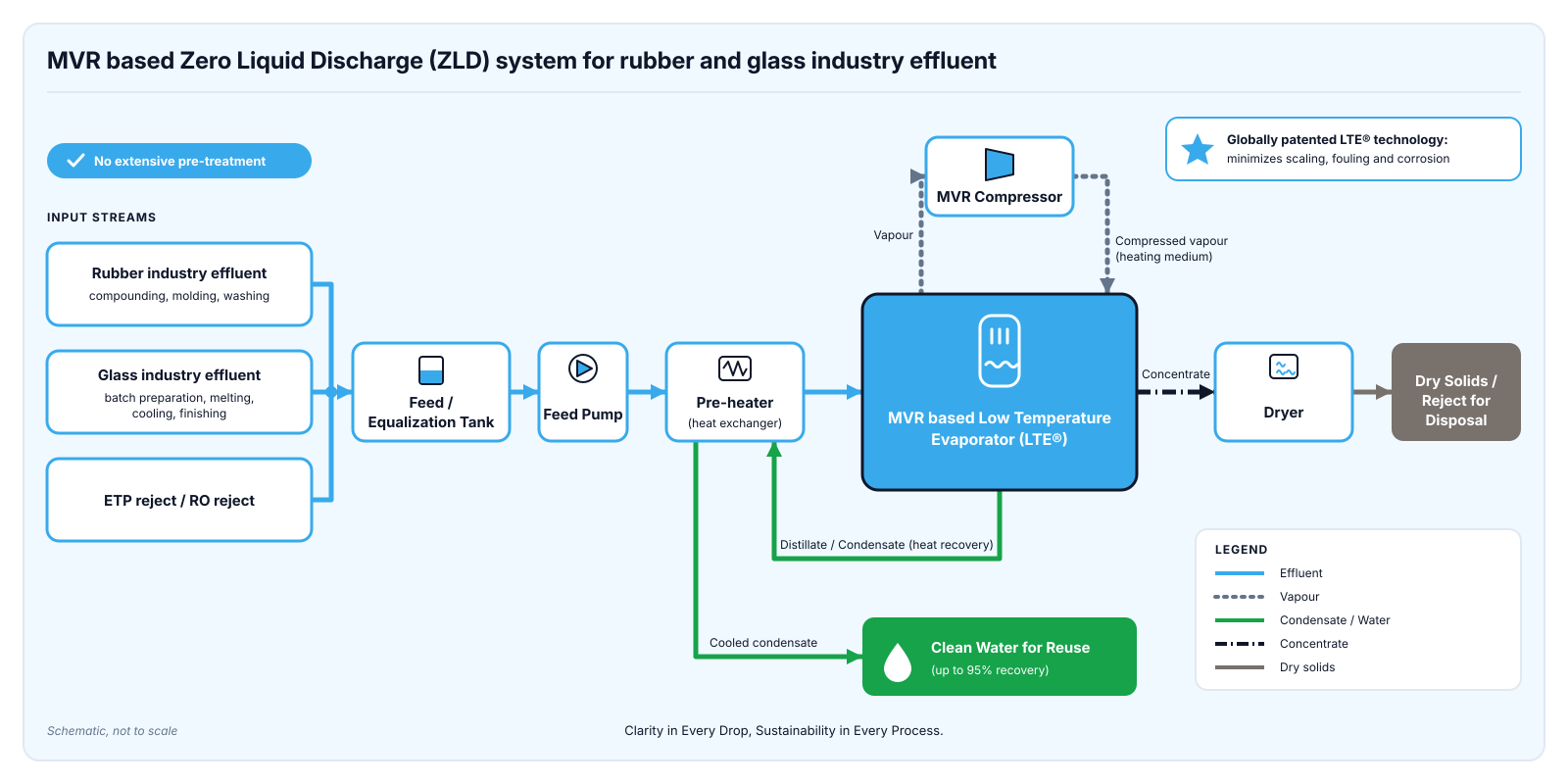
Advantages of MVR based ZLD

Engineered to handle diverse wastewater streams and flow capacities - direct effluent, effluent treatment plant reject, and RO reject with ease.

No extensive pre-treatment requirements.

Tailored to handle variable, high load & adaptable to influent fluctuations.

Automated operation with low manpower requirement.

Condensate recovery & reuse conserves up to 95% of raw resources.

Compact design reduces footprint area, installation time, and site preparation requirements.
Globally patented low temperature evaporation technology minimizes scaling, fouling and corrosion.